Wednesday, May 8, 2013

Acts 21:1- 22:5

Well yesterday caught up to me.  Sorry for not posting. Although I didn't post, I was able to spend some time reading the selected passage for the day.

Over the past two days the story has continued with Paul and the others making their way back to Jerusalem.  They realize that Paul will be arrested and yet Paul is still determined to go.  When Paul and the others arrive in Jerusalem they immediately meet with James and their fellow followers. Part of the stir around Paul is a rumor  that Paul is teaching the Jews to forsake the laws of Moses.  At the urging of James and as a way to quell the rumor Paul undergoes the rites of purification. However, Jews from Asia show up and rile up the crowd.  Paul is arrested, but convinces the tribune to allow him to address the crowd.  The story ends with Paul giving his pedigree a "Jew born in Tarsus..." Tomorrow  Paul's speech will continue with the crowd hearing the story of his conversion.

As we were reading yesterday's story, my daughter asked, "Does God want Paul to die?"  The question took my breath away and didn't have a response for the moment. Once I collected myself I said this,  "God has given Paul a mission to fulfill and sometimes with that mission bad things might happen and in this case Paul might be killed. That doesn't mean that Paul is not called to follow the path that God has laid out before him."

Where has God called you to do something that has been less than popular, that may put you in danger?

Monday, May 6, 2013

Paul's Farewell to Ephesus Acts 20:17-38

Paul seems to have a sense that his ministry is winding down, that the end is near. He is heading to Jerusalem and although he isn't certain what's about to happen, the Spirit of God has told him that afflictions and prison await. In our reading today, Paul says goodbye to the church in Ephesus with a real sense that they will never see his face again.  We hear how Paul commends the church to God, encourage the church to beware that some may come after him to try to deceive the church  and, perhaps most importantly,  reminds them that they are shepherds of the church.  As the passage closes Paul falls on his knees and pray for the people.  Tears flow, the people and Paul embrace, and Paul is sent on his way.

I was quite struck in verse 28 by Paul's reminder to the church at Ephesus that Spirit has made them shepherds of the church of God.  Being a person who wears a white piece of plastic around my neck (a clergy collar) I feel very much a shepherd of the church. But I wonder how I might as a leader in the church better encourage lay folks in my midst to live more fully into being a shepherd.  For the lay folks out there, how do you see yourself as a shepherd of the church  of God and how might your clergy help you to be a better shepherd?

Sunday, May 5, 2013

Acts 20:1-16 Eutychus Raised From the Dead at Troas

In today’s reading Paul is on the move again. After encouraging the disciples in Ephesus he leaves for Macedonia and Greece. Paul encourages believers as travels to Greece. Luke joins up with Paul at Troas again as he starts to speak in the first person once more.

While in Troas the believers come together to break bread and listen to Paul. It must have been one heck of a sermon; we don’t know when he started to speak but he kept talking until midnight. It seems no one really minded, but one person must have gotten tired. Eutychus, a young man, was sitting in a window and fell into a deep sleep. He was so sound asleep that he fell from the third story window to his death.

But this is not the end of the story! Paul runs down to the street, throws himself on Eutychus and put his arms around him. Then Paul announces that he is alive! Paul was not easily side-tracked by little things like death and resurrection so he goes back upstairs to break bread and eat. He continues talking until morning when he leaves for Assos. Oh yeah, by the way, the people took the young man home alive and were greatly comforted.

Paul continues traveling towards Jerusalem. He wanted to get there before Pentecost, if possible. It seems that Paul was in a hurry now and wasn’t taking a lot of time for preaching or spreading the Gospel.

I’m amazed by Paul’s stamina. The man has been traveling, mostly by foot, nonstop. When he does stop he is teaching, preaching and encouraging. This is a man of action! Apparently he doesn’t need sleep either. He spends days going from one place to the next, stops at Troas to give the longest sermon ever and in the middle of it raises a young man from the dead. Once he is done preaching he is on the road again.

How does he do it? Even Jesus rested and prayed. I notice that Luke doesn’t talk about Paul going off to pray. There is no mention of rest thus far either. Is Paul the first “Energizer Bunny”? Can he really just keep going, and going, and going?

I think that we are to learn from Paul to be people of action. We are to keep moving toward Jesus, teaching, preaching and encouraging along the way. But I also think we must stop and rest too. We must separate ourselves and pray, because Jesus is the source of energy and love.

So, I plan on resting today. It is the Sabbath after all. I will worship at church and then I may take a walk, take a nap or play a game with the kids. Then tomorrow I can be a person of action, sharing the Good News with everyone I encounter. How will you rest today?

Saturday, May 4, 2013

Acts 19:21-41 The Riot in Ephesus

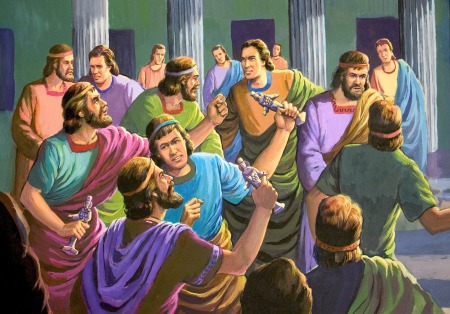
Luke tells us of a different trouble today. While Paul is still in Ephesus a silversmith, Demetrius, who is getting rich off of the worship of Artemis gathers all of the artisans. He gets them all riled up by saying that they are in danger of losing business because of Paul. Paul is convincing many people to convert to the Way (Christianity) and telling them not to worship false idols; gods made by man.
The Riot in Ephesus 
The artisans begin shouting and this causes a riot. The unruly crowd descends on the theater with Gaius and Aristarchus, Paul’s traveling companions, in tow. Paul wants to speak to the crowd, but the disciples wouldn’t let him. Luke tells us that most people did not even know why they were there. Somehow Alexander gets pushed to the front and managers to get everyone’s attention. But they realize he is a Jew so the crowd shouts, “Great is Artemis of the Ephesians” for two hours.

Finally the city clerk is able to silence the crowd. He tells them that the whole world knows Ephesus is the guardian of Artemis’ temple and image. He tells the crowd there is no reason for bringing Gaius and Aristarchus to the theater because they have not stolen from the temples or blasphemed their goddess. He tells them if they have a grievance it should be brought before the courts. They have no business causing a riot since there is no reason for it. Then he dismisses the assembly.

I am amazed that one person can cause so much trouble. Presumably, things are going fine and everything is peaceful until one person gets scared of something new. He is afraid that this “new thing” in town will affect him in a negative way. Demetrius doesn’t want to lose customers which would lead to a loss of income. It’s money he is concerned about, not faith. Although he uses the Ephesians faith in Artemis to spread the fear.

How easily we follow others, go along with the crowd. How quick we are to believe and trust what someone is telling us. We let the fear seize us and act in ways that we wouldn’t otherwise. We shout hateful words and treat others with disrespect. We don’t even realize what is happening.

Then comes the voice of reason, one person to point out the ridiculousness of the situation. I doubt the city clerk thought of himself as a prophet, but that day he was. He calmed the crowd down and pointed out the absurdity of their shouts. He let them know what actions would be appropriate. How deflated the crowd must have felt after realizing how absurd their actions were. Did they leave saying to one another, “what just happened?” Or “I can’t believe I got sucked into that.”

Which person are you in times of change and uncertainty, do you get caught up with the crowd or are you the voice of reason?

Friday, May 3, 2013

Acts 19:1-20 Paul in Ephesus

In today’s reading, Paul goes to Ephesus by a northern route. Paul meets believers in Ephesus but they have not received the Holy Spirit. They were given John’s baptism. Paul explains that John’s baptism was a baptism of repentance. Paul says that John told the people to believe in the one that came after him. Paul than explains that John was pointing to Jesus. He then baptizes them in the name of Jesus and as soon as Paul lays his hands on them they receive the Holy Spirit. The new believers begin to speak in tongues and prophesy. The number of new believers were about twelve.

Paul then speaks boldly in the synagogue for three months. Once again some Jews refused to believe so they opposed the Way. Paul left them and took the disciples to the hall of Tyrannus. Luke tells us that this went on for about two years so that everyone, Jew and Greek, in Asia heard the word of the Lord. Luke makes a point of telling us that God did extraordinary miracles through Paul. The Spirit is so strong with Paul that even things he has touched heal people and drive out evil spirits.

As always there is a problem, this time it is a bit different though. Some Jews are going around driving out evil spirits. They try to invoke Jesus’ name but it back fires on them. They tell the evil spirit to come out in the name of Jesus, whom Paul preaches. The spirit says, “I know Jesus and I know about Paul, but who are you?”  They receive a terrible beating for their trouble. Because of this incident many people are seized in fear and the name of Jesus is held in high honor. There was a great number of confessions and even burning of scrolls used for sorcery. Luke tells us that the word of the Lord spread widely and grew in power.

As I read this passage, Luke’s use of fear, confession and the word of the Lord growing in power. This is the first time Luke talks about people being seized with fear and honoring the name of Jesus together. Thus far we have heard about the Good News of Christ and all the miracles performed through the Holy Spirit. Now the power is connected to fear and confession.

I wonder, is this a reminder that I am a sinner. A reminder that I cannot receive the full power of the glory of Christ unless I confess my sins. What are the scrolls that I must burn so that I can receive all the gifts God has for me?  

Thursday, May 2, 2013

Paul shaves his head? Acts 18

Did anyone else notice that buried in the midst of today's reading was this small detail about Paul making a trip to the barber's shop in Cenchrae?  I literally had to look twice at the text to see if I had read what I had just read.  And, yes indeed Paul cut his hair because Luke says he had a vow.  Now it seems that Paul might have been a Nazirite, a Jew who had dedicated himself to God in a unique way.  As a Nazirite, he may have taken vows to avoid alcoholic drinks and engage in certaining grooming habits, like cutting his hair every 30 days or  growing his hair out and shaving his head upon completion of his Nazirite vow. Biblical scholar are not in agreement about whether or not this shaving his head was a regular part of his vow or the completion of the vows he had made.  After learning that Paul may have taken vows as a way to dedicate his life to God, I began thinking about the vows we make as Christians.  Certainly those of us who have been baptized and confirmed have take vows about how  we will follow Christ. For those of us who are ordained we have taken ordination vows about how we will serve Christ and His church.  Like Paul, most of us have promised to follow God in certain ways. I wonder how are you fulfilling your baptismal promises and vows? Where do you struggle to keep the vows you've made?  

F.Y.I.: Just taking The Challenge fulfills at least one of our baptismal vows, "to continue in the Apostles teaching..." Keep up the good work.  

Wednesday, May 1, 2013

Paul at Corinth

Today the story takes us to Corinth and describes Paul's time there. While in Corinth Paul spends time in the synagogue  on the sabbath preaching Jesus as the messiah. As you can imagine this gets Paul into some hot water with the Jews.  Luke tells us that when the Jews "oppose" Paul, he shake the dust off his clothes in protest and declares that from now on he will go to the Gentiles.  Some time later, God gives Paul a pep talk reminding him that whenever Paul speaks He with be with him.  Luke then points out that Paul stayed in Corinth a year and a half.  Are we to think that this pep talk persuades Paul to continue his mission in Corinth, had he been ready to throw in the towel before God shows up in a vision?  The story closes today with Gallio, a Roman official,washing his hands of Paul.  Gallio refers Paul him back to Jewish officials who were trying to get the Romans involved to punish Paul  for persuading the people to worship God in ways contrary to the law.

I noticed a number of similarities in today's story with stories from the Gospels.

1.  Disciples are instructed by Jesus to shake the dust off their feet when they are not accepted someplace.  Paul shakes the dust off his clothes when the Jews fail to accept.

2. Pilate on a number of occasions tries free himself of dealing with Jesus when the Jews bring Christ before Pilate. Gallio dismisses Paul back to the Jews claiming the charges have to do with Jewish laws and not Roman Law.  

Where have you seen similarities between the story in Acts and the story we hear about in the Gospels?